Table Of Content

This will also give students the chance to practice and apply skills in a variety of contexts, incorporate feedback, and get the practice they need to meet upcoming challenges in the course. For these same reasons, your assessment methods will ideally incorporate various degrees of difficulty or skill integration over the semester. Your completed Course Plan should lay out, in brief, the weekly assessments, course content, and teaching strategies and activities that align to the learning outcomes you create in Step 2 below. At this stage it is important to consider a wide range of assessment methods in order to ensure that students are being assess over the goals the instructor wants students to attain. Sometimes, the assessments do not match the learning goals, and it becomes a frustrating experience for students and instructors. Use the list below to help brainstorm assessment methods for the learning goals of the course.
For Programs and Units
If your ILO states that students will be able to describe some phenomenon, don’t use a true/false or multiple-choice question to measure their attainment of this outcome. How you evaluate and grade an assessment should also track with your intended learning outcomes. A well-designed rubric can help you align your assessments to your intended learning outcomes. This last example provides intended learning outcomes for a subject focused more on soft skills, where measuring student ability objectively is significantly more nuanced and difficult.
Backward design lesson planning – What is it & why you should use it
Imagine planning a road trip by first thinking about the destination, and then figuring out all the best stops and routes along the way. Well, there's a good chance the person teaching you used Backward Design to plan that awesome learning experience. We recognise the Ongoing Custodians of the lands and waterways where we work and live. We pay respect to Elders past and present as ongoing teachers of knowledge, songlines and stories.
Stage 3: Plan Learning Activities and Instructional Materials
Once you've determined what your students need to know, the next step is to figure out how to assess whether they have learned what they are supposed to learn. In addition, the teacher needs to decide how the evidence will be collected in a fair and consistent way that evaluates transfer of this knowledge. For many teachers, planning the assessments before planning the lessons seems counterintuitive, but it is the best way to focus instruction on what students really need to know. Backward Design allows for a more accurate and meaningful assessment of student learning. Experts like Dylan Wiliam have pointed out that because assessments are aligned with learning objectives from the get-go, they are more likely to be valid measures of student understanding and skill.
Center for the Advancement of Teaching Excellence (CATE)
Activities can be passive such as listening to a lecture or watching a video, or active such as using manipulatives in math or holding small group discussions. In addition to the formative assessments that are used informally to guide instruction, summative assessments are used to gather evidence to determine what students have learned. Students should be able to justify their answers, apply their knowledge to other situations, and even teach others if they have truly mastered a concept. Planning starts with defining the learning goal and identifying the central question for the lesson. The second step establishes a definable target, an objective that you can measure.
Redesigned 2022 Lexus LX 600 Gets Twin-turbo V6, VIP Cabin - The Car Guide
Redesigned 2022 Lexus LX 600 Gets Twin-turbo V6, VIP Cabin.
Posted: Wed, 13 Oct 2021 07:00:00 GMT [source]
If you have a goal that has zero corresponding outcomes, it should not be a learning goal for your course. If you have a goal that has far too many corresponding outcomes, there may be another goal floating among them that you haven't articulated yet. If you have learning goals that are closely related, you may have learning outcomes that correspond to more than one goal in your course. This common approach to course design looks reasonable at first glance, but it also presents some challenges. As experts in their fields, instructors are not always the best judges of what their more novice students might find engaging.
For Educators
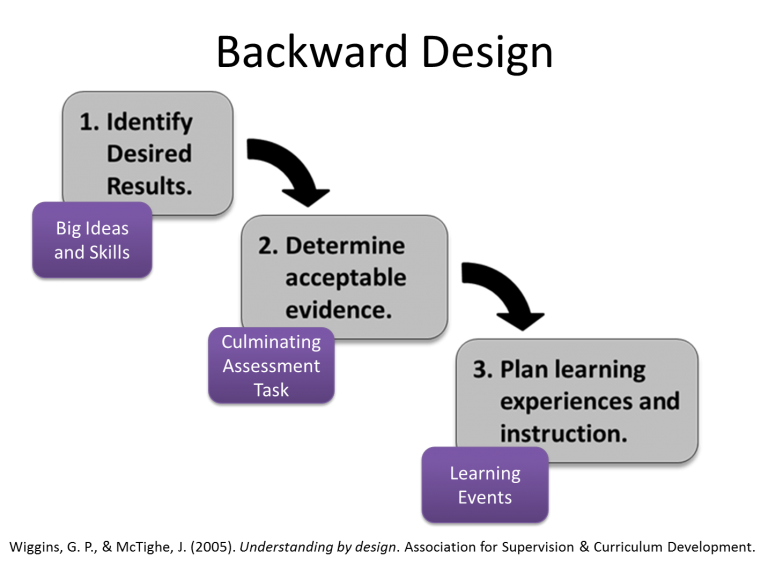
The “backward design” model exemplified here is developed in considerable detail by Grant Wiggins and Jay McTighe in their book Understanding By Design. While most of the examples in that book come from K-12 education, their method can be adapted to university education. As educational paradigms continue to evolve, frameworks like Backward Design will likely undergo revisions and adaptations. Current trends in educational technology, personalized learning, and inclusive education all offer exciting avenues for integrating and evolving the principles of Backward Design. For those new to Backward Design, diving in with an entire curriculum may feel overwhelming. Educational consultant and author Heidi Hayes Jacobs recommends starting with a single unit or even just one lesson.
The knowledge and skills at this substage are considered important to know and do. The information that fits within this question could be the facts, concepts, principles, processes, strategies, and methods students should know when they leave the course. The teacher has created an authentic task in which students will design a 3-day meal plan for a camp that uses food pyramid guidelines. By way of example, consider a paralegal instructor who wants students, as a result of her instruction, to be able to prepare case briefs.
This method is rooted in the constructivist theories of educators like Jean Piaget. Like Backward Design, Inquiry-Based Learning encourages higher-order thinking skills. However, it differs in that the learning process is far less structured, often initiated by a question or problem posed by the students themselves rather than pre-defined learning objectives. You might hear teachers asking, "What are the desired outcomes?" or "What evidence of learning will we accept?" These questions show that the influence of Backward Design is widespread and still growing. Backward design provides a relevant context for students as they engage in learning activities.
Backward Design serves as more than just a tool for curriculum planning; it represents a shift in how we think about education. Instead of starting with what educators want to do, it starts with what students need to learn. This learner-centered focus makes it a powerful approach for modern education, where student engagement and outcomes are increasingly emphasized. Educational technology experts like Dr. Ruben Puentedura, known for the SAMR model, suggest that technology can play a powerful role in implementing Backward Design. Whether it's digital assessments or interactive activities, technology can offer innovative ways to achieve your learning objectives.

Once you're comfortable with the approach, you can expand to more complex planning projects. While these challenges and criticisms provide a more nuanced view of Backward Design, they don’t necessarily invalidate its effectiveness. Many educators find ways to adapt the approach to suit different learning environments and needs. Because understanding how Backward Design works can make anyone a better learner and even a better teacher, whether you're helping your kid with homework or leading a team at work.
Tesla Model 3 Getting Out of Tight Garage Using The Summon Forward and Backward - Torque News
Tesla Model 3 Getting Out of Tight Garage Using The Summon Forward and Backward.
Posted: Sat, 22 Jun 2019 07:00:00 GMT [source]
Traditional or “frontloading” and backwards or “backloading” design models are used to create curriculum, and both have benefits. In schools or districts where aims, goals and objectives are the focus, the traditional model is probably the best choice. In many districts, backwards design is used because there is an expectation that students should attain high test scores.
Crafting realistic learning outcomes requires some understanding of students’ prior knowledge and skills in your subject. Looking ahead to step two of backward design, you will need to identify evidence that an intended learning outcome has been obtained. If a learning outcome is not measurable, then we will not be able to know whether or not our course successfully achieved its goals.
Pursuant to the Backward Design model, desired results of instruction might be based upon national, state and local standards. This model prioritizes knowledge and focuses on what is most important for students to understand and achieve. Arguably, if design begins with the end in mind, instruction is more likely to clearly focus on the identified desired results[3]. Your learning outcomes should be achievable for the students in your class and achievable in the time allotted to your subject.
This prevents your tests and assessments from feeling useless at best and contrary or irrelevant to your students at worst. The following examples are simply suggestions for what creating backward design lesson plans might look like. When creating your own lesson plans, please refer to your state’s or school’s specific academic standards. What do you want students to know or be able to do at the end — explain how cells work? (16 PD Hours) This course will teach you the different types of assessments, how to design effective and targeted assessment items, and how to build a detailed plan for your content area and grade-level to measure student progress. In short, by using backward design, an instructor chooses all course materials and activities in order to support an end objective rather than defining the end objective as a summary of the materials covered along the way.